A practical guide to bird watching in Sonoma County, California
(Unless otherwise indicated, all phone numbers are in the 707 area code)
A practical guide to bird watching in Sonoma County, California
(Unless otherwise indicated, all phone numbers are in the 707 area code)

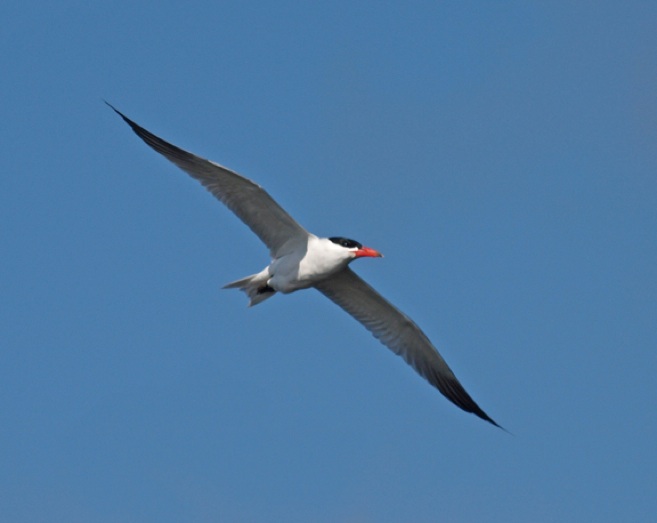
The largest tern, Caspian Tern is a fairly common summer visitor to Sonoma County, probably best seen at Bodega Bay or around Jenner, at the mouth of the Russian River, where you can watch them hovering over the water and then diving for fish. Birds may arrive as early as late March and usually stay until around mid-October. Although adults can sometimes be seen feeding immature birds mid-summer, Sonoma County Breeding Bird Atlas has no confirmed breeding records for the county (according to The Birder's Handbook, Caspian Terns feed immature birds for as long as 5-7 months after fledging). In 2006, Caspian Tern was moved to the genus Hydroprogne. Older sources will list this bird as Sterna caspia.
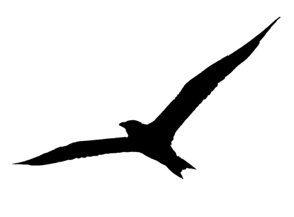
Finally, a note of caution: As with the gulls, the terns can be variable and plumages change with age and season. While I believe the general points above to be accurate and useful, terns can be quite confusing, not least because they are often seen at a distance and on the wing, or at a distance and hunkered down on the ground. No one field mark is ever reliable. If you're serious about learning terns, I recommend the detailed discussions in the Kaufman guides listed below. (That said, Caspian Tern and Elegant tern are usually not big identification problems among the terns in Sonoma County. The biggest mistake is probably assuming that all summer (breeding plumage) terns here that look like a Forster's Tern actually are Forster's Terns without really taking a good look to see if you might have a Common Tern, or less probably, an Arctic Tern. While chances are good that it is a Forster's Tern, it's worth looking to be sure.)
Further reading:
Bolander and Parmeter, Birds of Sonoma County California, rev. ed., 2000, p. 64
Brinkley, National Wildlife Federation Field Guide to Birds of North America, 2007, p. 139
Dunn and Alderfer, eds., National Geographic Field Guide to the Birds of North America, 5th ed., 2006, p. 218
Dunn and Alderfer, eds., National Geographic Field Guide to the Birds of North America, 6th ed., 2011, p. 244
Dunne, Pete Dunne’s Essential Field Guide Companion, 2006, pp. 277-278
Ehrlich, Dobkin, and Wheye, The Birder's Handbook, paperback edition, 1988, p. 192
Fix and Bezener, Birds of Northern California, 2000, p. 183
Floyd, Smithsonian Field Guide to the Birds of North America, 2008, p. 202
Kaufman, Field Guide to Birds of North America, 2000, p. 90
Kaufman, Field Guide to Advanced Birding, 2011, (notes on identifying terns generally; pp. 272-284); 273, 277, 278, 281, 282, 284
Lukas, Bay Area Birds: From Sonoma County to Monterey Bay, 2012, pp. 132-134
Parmeter and Wight, Birds of Sonoma County California, Update (2000-2010), 2012, p. 36
Peterson, Birds of Eastern and Central North America, 5th ed., 2002, p. 186
Peterson, Field Guide to Birds of Western North America, 4th ed., 2010, p. 174, 190
Peterson, Western Birds, 3rd ed., 1990, p. 104
Sibley, Field Guide to Birds of Western North America,1st ed., 2003, p. 202
Stokes, Stokes Field Guide to the Birds of North America, 1st ed., 2010, p. 345
Vuilleumier, American Museum of Natural History, Birds of North America: Western Region, 2011, p. 176
Voice: Cornell Lab of Ornithology: All About Birds--Caspian Tern
© Colin Talcroft, 2009, 2010, 2011, 2012, 2013
Unless noted, all photos by the author. If you would like to use one of my images, please ask for permission for non-commercial use with proper credit or commercial use with proper compensation.
Caspian Tern: Note heavy dark red bill; black at the tips of the undersides of the wings
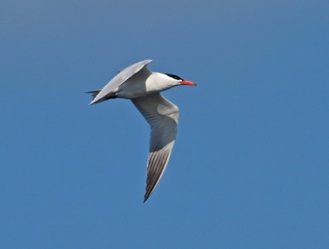
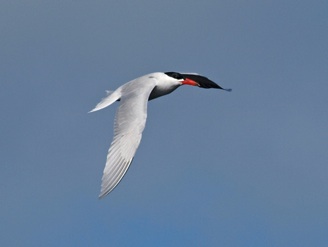
Caspian Tern: Note heavy dark red bill; clear, pale grey upper sides of the wings, shallow fork in the tail
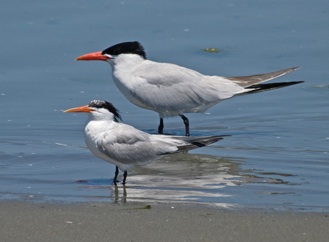
Size comparison: Elegant Tern in the foreground, Caspian Tern behind. In addition to its greater size, note Caspian Tern's large, squarish head; heavy, red bill.
Bodega Bay, July 6, 2011
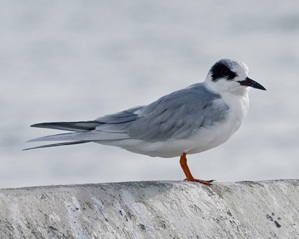
For comparison: Forster's Tern (winter plumage)--Note shorter, lighter bill (black in in non-breeding, winter plumage); mostly white head with black around the eye; red feet
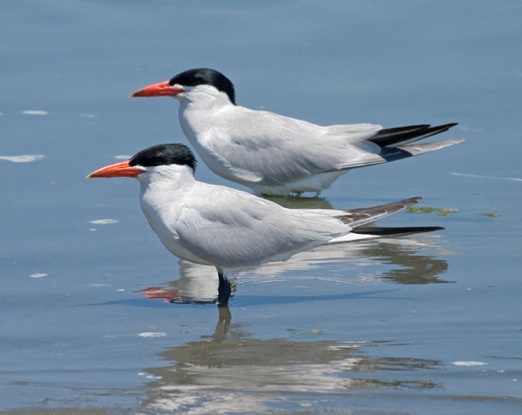
Caspian Terns standing
Bodega Bay, July 6, 2011
Caspian Tern
Hydroprogne caspia
Caspian Tern, Bodega Bay, July 6, 2011
EBird reported occurrence in Sonoma County
1990-2013 Sonoma County data. Graph provided by eBird (www.ebird.org), generated May 30, 2013
