A practical guide to bird watching in Sonoma County, California
(Unless otherwise indicated, all phone numbers are in the 707 area code)
A practical guide to bird watching in Sonoma County, California
(Unless otherwise indicated, all phone numbers are in the 707 area code)


Common Merganser is present throughout the year in Sonoma County but seems much more common in the winter. According to Bolander and Parmeter, Common Merganser stays close to large streams mostly in the western part of the county during breeding season (Common Mergaser is known to breed along the Russian River, Austin Creek, and on the Gualala River and tributaries) and then disperses during the winter, moving to natural ponds and lakes and to farm ponds, reservoirs, and sewage treatment ponds. A group usually spends the winter at Lake Ralphine in Santa Rosa. Common in the winter also at Santa Rosa's Place to Play Park. Almost never found in saltwater habitats.
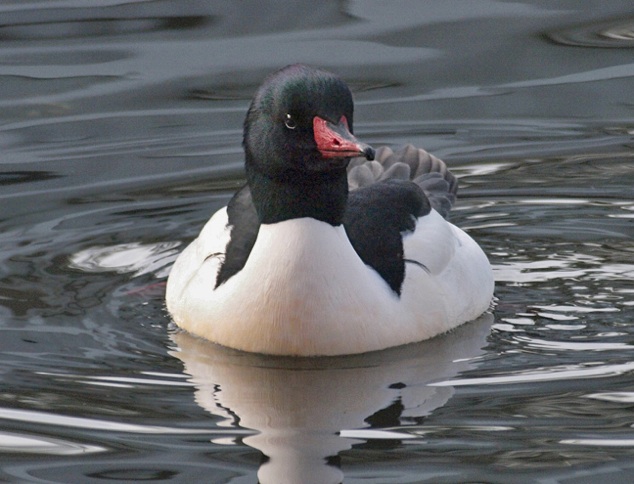
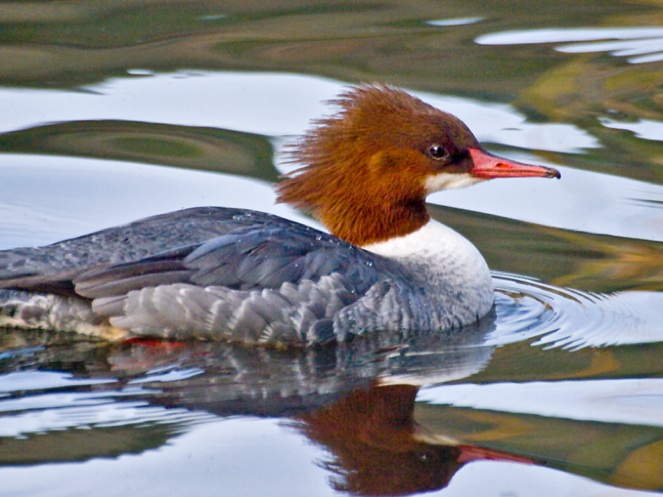
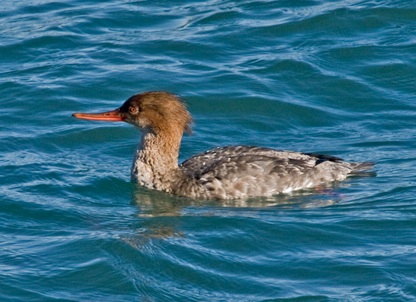
Common Merganser is a striking example of sexual dimorphism. If you didn't already know better, you'd think the males and females were representatives of two different species. The male Common Merganser (above) has a deep green head with a purple sheen that appears almost black in some lights. The rest of the bird is mostly white (a subtle rosy blush at the breast is easy to miss), except that the back is nearly black and the tail is a deep silvery grey. The bright red bill, with serrated edges (for holding fish) and a hooked tip, contrasts sharply with the dark head. The feet are bright red as well. The females (below) share the red bill and feet with male birds, but otherwise look quite different. They are flaming redheads that always seem in need of a haircut. They have white under the chin and are white on the breast and on the bottom half of the neck, with a clear line of demarcation between the white there and the rusty red of the head (this clear line of separation is one feature that distinguishes female Common Merganser from the similar-looking female Red-breasted Merganser (Mergus serrator); female Common Merganser is also stockier and less elongated looking, it has a thicker bill than Red-breasted Merganser, and its shaggy crest looks neat compared with the even more ragged looking crest of female Red-breasted Merganser). Otherwise, female Common Mergansers are a silvery grey. Females have a white wing patch, conspicuous in flight, that may show as a stripe of white on the flank, but the stripe is often not visible.
Trivia: Known in Britain as the Goosander.
The challenges of female duck identification (includes a quiz)
Further reading:
Bolander and Parmeter, Birds of Sonoma County California, rev. ed., 2000, p. 37
Brinkley, National Wildlife Federation Field Guide to Birds of North America, 2007, p. 54
Burridge, ed., Sonoma County Breeding Bird Atlas, 1995, p. 42
Dunn and Alderfer, eds., National Geographic Field Guide to the Birds of North America, 5th ed., 2006, p. 48
Dunn and Alderfer, eds., National Geographic Field Guide to the Birds of North America, 6th ed., 2011, p. 46
Dunne, Pete Dunne’s Essential Field Guide Companion, 2006, pp. 64-65
Ehrlich, Dobkin, and Wheye, The Birder's Handbook, paperback edition, 1988, p. 92
Fix and Bezener, Birds of Northern California, 2000, p. 100
Floyd, Smithsonian Field Guide to the Birds of North America, 2008, p. 54
Kaufman, Field Guide to Birds of North America, 2000, p. 42
Kaufman, Advanced Birding, 1990, pp. 48-50 (general notes on duck ID), pp. 49-50
Kaufman, Field Guide to Advanced Birding, 2011, pp. 149
Lukas, Bay Area Birds: From Sonoma County to Monterey Bay, 2012, pp. 27-29
Parmeter and Wight, Birds of Sonoma County California, Update (2000-2010), 2012, p. 10
Peterson, Birds of Eastern and Central North America, 5th ed., 2002, pp. 80, 82
Peterson, Field Guide to Birds of Western North America, 4th ed., 2010, p. 40, 44
Peterson, Western Birds, 3rd ed., 1990, pp. 60, 68
Sibley, Field Guide to Birds of Western North America,1st ed., 2003, p. 92
Stokes, Stokes Field Guide to the Birds of North America, 1st ed., 2010, p. 50
Vuilleumier, American Museum of Natural History, Birds of North America: Western Region, 2011, p. 67
Voice: Cornell Lab of Ornithology: All About Birds--Common Merganser
© Colin Talcroft, 2009, 2010, 2011, 2012, 2013
Unless noted, all photos by the author. If you would like to use one of my images, please ask for permission for non-commercial use with proper credit or commercial use with proper compensation.
Common Merganser, Lake Ralphine, Santa Rosa, December 17, 2009
Female Common Merganser, Lake Ralphine, Santa Rosa, December 17, 2009
For comparison: Female Red-breasted Merganser
Campbell Cove, Bodega Bay, January 11, 2012
Note: Duller brown head; red eye; thinner, more orange-tinted bill; lack of white at upper breast; duller grey back and flanks
Common Merganser
Mergus merganser
EBird reported occurrence in Sonoma County
1990-2013 Sonoma County data. Graph provided by eBird (www.ebird.org), generated May 30, 2013